What Is LDM (Loading Metre)? How to Calculate It
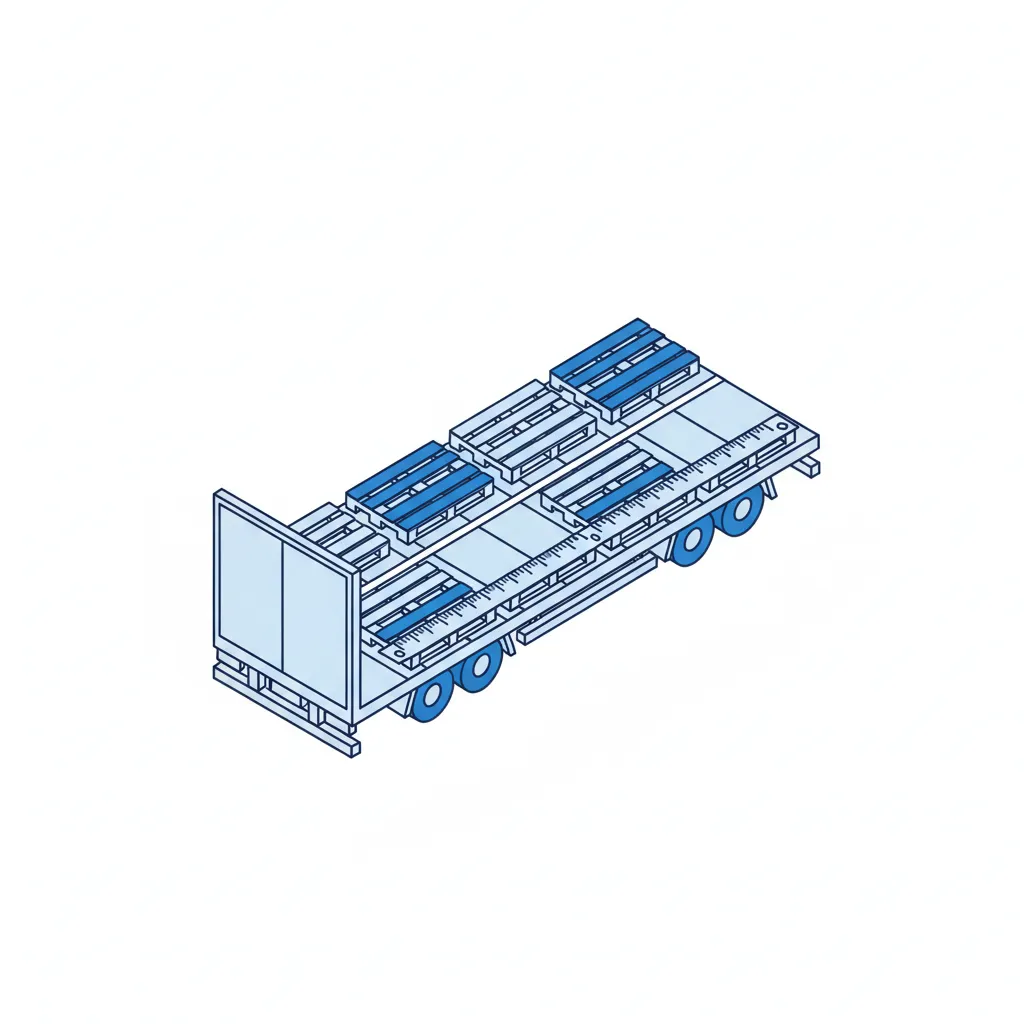
LDM (loading metre) is one metre of length along a standard 13.6 m truck deck, across the full 2.4 m width. It tells a carrier how much trailer floor your shipment eats up, which is what they actually charge for on part-load freight. So when you ask "what is LDM", the short answer is: it is a length measure, not a weight or a pallet count, and it is the number that decides what you pay for a groupage shipment.
If your goods are heavy and small, weight drives the price. If they are light and bulky, LDM drives it. Carriers quote on whichever is larger.
LDM (loading metre) in one sentence
A loading metre equals 1 metre of deck length over the standard trailer width of 2.4 m, so one LDM covers 2.4 m² of floor space. A full standard tilt trailer is 13.6 m long, which means it holds 13.6 LDM in total.
The whole point of the ldm meaning is fairness on shared trucks. On a part-load (LTL) run from Vilnius to Hamburg, you and four other shippers share the same deck. Nobody is paying for the whole trailer, so the carrier needs a way to split the cost by how much room each load takes. That unit is the loading metre.
The formula: how LDM is calculated
Here is how to calculate LDM for any item or pallet:
LDM = (item length in m × item width in m) ÷ 2.4
You take the footprint area on the floor, then divide by the standard trailer width (2.4 m). For multiple identical items, multiply by quantity first, then divide.
Worked example - one block of pallets:
- 10 EUR pallets, each 1.2 m × 0.8 m
- Footprint per pallet: 1.2 × 0.8 = 0.96 m²
- Total footprint: 0.96 × 10 = 9.6 m²
- LDM: 9.6 ÷ 2.4 = 4.0 LDM
So ten non-stackable EUR pallets occupy 4 loading metres. On a Vilnius→Hamburg lane priced around €38–€48 per LDM, that block costs roughly €152–€192 in deck space alone, before fuel surcharge or tolls.
The maths is mechanical but easy to get wrong under time pressure. Skip the maths - use the free loading-meters calculator, then quote the lane on UMERA.
Why LDM sets your LTL price
On full truckloads (FTL) you pay for the whole trailer, so LDM rarely matters - you booked the deck. On part-loads it is everything, because the carrier is selling slices of one trailer to several customers at once.
A carrier looks at three numbers and charges on whichever is worst for them:
| Driver | Standard cap (13.6 m tilt) | When it wins |
|---|---|---|
| Loading metres | 13.6 LDM | Light, bulky goods (foam, furniture, empty packaging) |
| Weight | ~24 t payload | Dense goods (steel, tiles, liquids) |
| Volume | ~90–100 m³ | Very light, very voluminous goods |
This is why two shipments of the same weight can be quoted differently: the bulkier one books more metres. Knowing your LDM before you ask for prices means you can sanity-check a quote instead of taking it on trust. When you send the same lane to five carriers you usually see a 15–30% spread, and a wrong LDM on your request can widen that spread for no reason.
Converting pallets to LDM (table: euro vs industrial)
The fastest ldm to pallets shortcut is to memorise the two common pallet footprints. A EUR pallet is 1.2 m × 0.8 m. An industrial (EPAL 3 / "block") pallet is 1.2 m × 1.0 m. Both load with the 1.2 m side across the trailer, so the difference comes from depth.
| Pallets (non-stackable) | EUR pallet (1.2 × 0.8 m) | Industrial pallet (1.2 × 1.0 m) |
|---|---|---|
| 1 | 0.4 LDM | 0.5 LDM |
| 2 | 0.8 LDM | 1.0 LDM |
| 4 | 1.6 LDM | 2.0 LDM |
| 6 | 2.4 LDM | 3.0 LDM |
| 10 | 4.0 LDM | 5.0 LDM |
| 33 (full trailer) | 13.2 LDM | — |
| 26 (full trailer) | — | 13.0 LDM |
Rule of thumb: one EUR pallet ≈ 0.4 LDM, one industrial pallet ≈ 0.5 LDM, when nothing stacks on top. For exact box dimensions and weights, check the euro pallet dimensions reference.
Stackable vs non-stackable - the catch
The biggest swing in your LDM bill is one checkbox: can the carrier put another pallet on top of yours?
- Non-stackable - the pallet uses its full floor footprint. 10 EUR pallets = 4.0 LDM (as above).
- Stackable (2-high) - the carrier loads a second pallet on top, so your floor footprint roughly halves. 10 stackable EUR pallets ≈ 2.0 LDM.
At €38–€48 per LDM, that is the difference between paying ~€152–€192 and ~€76–€96 for the same goods. If your cargo can take weight on top without crushing, say so on the booking - it directly cuts the deck space you are billed for.
The catch runs the other way too. If you mark goods stackable and they are not (fragile, top-heavy, or already at max pallet height), the carrier can re-rate the shipment at the higher non-stackable LDM, and you lose the dispute because the deck photo shows the truth. Be honest about stackability and the price holds.
General information only - not customs, tax or legal advice.
FAQ
What does LDM stand for?
LDM stands for loading metre (also written "lademeter" in German-speaking markets). It is one metre of trailer-deck length across the standard 2.4 m width, equal to 2.4 m² of floor space.
How many LDM are in a full truck?
A standard 13.6 m tilt trailer holds 13.6 LDM. That is the maximum any single shipment can occupy on a full load. In pallet terms it is about 33 EUR pallets or 26 industrial pallets on the floor.
How do I convert pallets to LDM?
Multiply each pallet's footprint (length × width) by quantity, then divide by 2.4. As a shortcut, one EUR pallet is about 0.4 LDM and one industrial pallet about 0.5 LDM when non-stackable. Halve those figures if the goods are stackable two-high.
Does LDM include the height of my goods?
No. LDM measures only the floor footprint, not height. Height matters separately - if a pallet exceeds the usable trailer height (around 2.6–3.0 m depending on trailer type) it cannot be stacked, which is why tall pallets are billed at full non-stackable LDM.
Is LDM the same as cubic metres?
No. Cubic metres (m³) measure volume in three dimensions; LDM measures only the deck length your footprint occupies. Carriers use both, plus weight, and quote on whichever gives the highest figure for your shipment.
Why do carriers charge by LDM instead of weight?
Because a trailer can run out of floor space long before it runs out of payload. Light, bulky freight fills the deck while the truck is far under its 24-tonne limit, so charging by LDM lets the carrier recover the cost of the space that load denies to other customers.
Ship smarter with UMERA
Paste an order - UMERA builds the RFQ and sends it to your own carriers in 60 seconds.