FTL vs LTL: What Full Truckload Means & When to Use
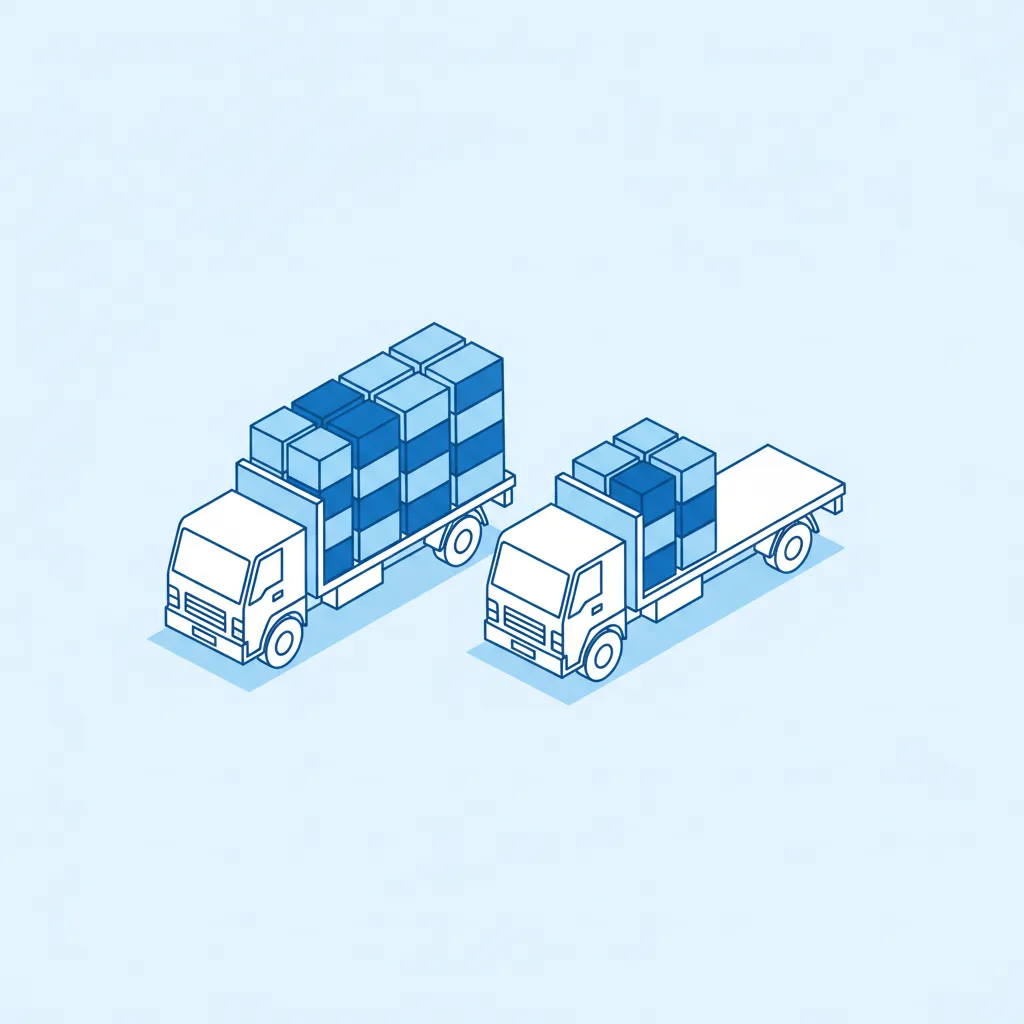
FTL stands for Full Truckload: you book an entire truck for your goods alone, and it drives straight from your dock to the delivery point with no other freight on board. LTL (Less than Truckload) is the opposite — your pallets share the trailer with shipments from other senders, so you only pay for the space you use, but the box stops at terminals along the way.
The choice between FTL and LTL comes down to three things: how many pallets you have, how fast you need them there, and how fragile they are. This guide gives you the full truckload meaning in plain terms, the LTL meaning beside it, and a pallet-count rule of thumb so you can decide in under a minute.
FTL and LTL in one table
The quickest way to keep them straight: FTL is one truck, one sender, one direct trip. LTL is one truck, many senders, several stops. Everything else follows from that.
| FTL (Full Truckload) | LTL (Less than Truckload) | |
|---|---|---|
| You pay for | The whole truck | Only the space you use (LDM / weight) |
| Other cargo on board | None — your goods only | Yes — shared with other senders |
| Routing | Direct, point to point | Via consolidation terminals |
| Typical transit | Faster (no detours) | Slower (sorting + extra stops) |
| Handling touches | Loaded once, unloaded once | Reloaded several times |
| Best for | ~13+ pallets, full loads, fragile goods | 1–6 pallets, small batches |
| Price basis | Flat rate per trip | Per loading meter or per kg |
Both move on the same standard tilt or curtain-sider trailer (about 13.6 m long, ~33 euro pallets, 24 t payload). The difference is whether that trailer is yours alone.
What "full truckload" actually means
A standard EU road trailer holds 33–34 euro pallets on the floor and carries up to around 24 tonnes. When your shipment fills most of that — by floor space, by weight, or by loading meters — you are in full-truckload territory and it makes sense to book the whole vehicle.
"Full" does not always mean the trailer is packed to the roof. You go FTL when any one of these is true:
- Space: your pallets need most of the 13.6 m of floor.
- Weight: you are near the ~24 t payload ceiling, even with few pallets (think steel, liquids, tiles).
- Speed or security: you want a direct trip with no terminal handling, regardless of how full the truck is.
That last point matters more than people expect. Even a half-empty truck booked as FTL skips the consolidation network entirely — fewer hands on your cargo, fewer days in transit.
The break-even: how many pallets/LDM tips you into FTL
Freight space is usually billed in loading meters (LDM) — one LDM is a 1-metre-deep strip across the full trailer width, roughly two euro pallets standing side by side. A full trailer is about 13.6 LDM.
As a working rule for non-stackable euro pallets:
- 1–6 pallets (up to ~3 LDM): LTL almost always cheaper.
- 7–12 pallets (~3.5–6 LDM): the grey zone — quote both ways.
- 13+ pallets (~6.5+ LDM): FTL usually wins on both price and speed.
The exact tipping point moves with the lane, the season, and how heavy your pallets are. To translate your actual pallet count and stacking into loading meters, run the numbers through the loading-meters calculator before you ask for quotes — it stops you from over- or under-booking space.
Not sure if it's FTL or LTL? Quote both to your carriers in 60 seconds and let the price spread decide for you.
Cost, speed, and handling-risk trade-offs
LTL looks cheaper per shipment because you only pay for your slice. But that slice carries hidden costs once volume climbs: more handling, slower transit, and a higher chance of damage.
| Factor | FTL | LTL |
|---|---|---|
| Cost on small loads (1–4 pallets) | Higher (paying for empty space) | Lower |
| Cost on large loads (13+ pallets) | Lower per pallet | Higher (LDM adds up) |
| Transit time, Vilnius→Hamburg (~1,150 km) | ~2 days direct | ~3–5 days via terminals |
| Handling touches | 2 (load, unload) | 4–8 (every terminal) |
| Damage risk | Low | Higher (more reloads) |
| Pickup/delivery flexibility | Booked slot, direct | Network schedule |
The handling number is the one coordinators underrate. Every terminal touch is a chance for a pallet to get crushed, mis-sorted, or delayed. For fragile, high-value, or oddly shaped goods, the direct FTL trip is often worth the premium even when LTL prices lower on paper.
A worked example: 6 vs 12 vs 22 pallets
Take a real lane — Vilnius → Hamburg, ~1,150 km, ~2 day direct transit — with non-stackable euro pallets averaging 400 kg each. These figures are illustrative ranges; your actual quotes will vary by carrier and week.
| Shipment | LDM used | LTL estimate | FTL estimate | Cheaper option |
|---|---|---|---|---|
| 6 pallets (2,400 kg) | ~3.0 | ~€620 | ~€1,150 | LTL |
| 12 pallets (4,800 kg) | ~6.0 | ~€1,150 | ~€1,200 | Roughly even — quote both |
| 22 pallets (8,800 kg) | ~11.0 | ~€2,050 | ~€1,250 | FTL |
Read across the table and the pattern is clear:
- At 6 pallets, LTL is far cheaper — you would waste two-thirds of an FTL trailer.
- At 12 pallets, the two land within ~€50 of each other. This is exactly the grey zone where you should price both before committing.
- At 22 pallets, the LTL meter has run past a full truck, so FTL wins on price and you get faster, lower-risk direct delivery.
To pressure-test your own lane and per-km rate, plug your distance and weight into the freight-rate calculator. When you send the same lane to five carriers you usually see a 15–30% spread, so the only way to know your real break-even is to collect actual quotes — not list rates.
FAQ
What is FTL in shipping?
FTL (Full Truckload) means you reserve an entire truck for your shipment. No other sender's freight rides with you, and the truck drives directly from pickup to delivery without stopping at consolidation terminals. You pay one flat rate for the whole vehicle.
What does LTL meaning come down to?
LTL (Less than Truckload) means your pallets share a trailer with shipments from other senders. You only pay for the loading meters or weight you use, which is cheaper for small batches — but the truck stops at terminals to sort cargo, so it is slower and your goods are handled more.
When should I use FTL instead of LTL?
Use FTL when you have roughly 13 or more euro pallets, when you are near the ~24 t weight ceiling, or when speed and low handling matter (fragile, high-value, or time-critical goods). Below about 6 pallets, LTL almost always costs less.
How many pallets is a full truckload?
A standard 13.6 m EU trailer holds 33–34 euro pallets on the floor and up to around 24 tonnes. You are effectively at full truckload when your cargo fills most of that floor space, weight, or loading meters.
Is FTL always faster than LTL?
Almost always, yes. FTL is loaded once and driven direct, while LTL passes through one or more consolidation terminals for sorting. On a lane like Vilnius→Hamburg, FTL runs about 2 days versus 3–5 days for LTL.
How do I work out my FTL vs LTL break-even?
Convert your pallets to loading meters, then get real quotes both ways. The crossover usually sits around 6–13 pallets but shifts with the lane and season. General information only — not customs, tax or legal advice.
Ship smarter with UMERA
Paste an order - UMERA builds the RFQ and sends it to your own carriers in 60 seconds.